
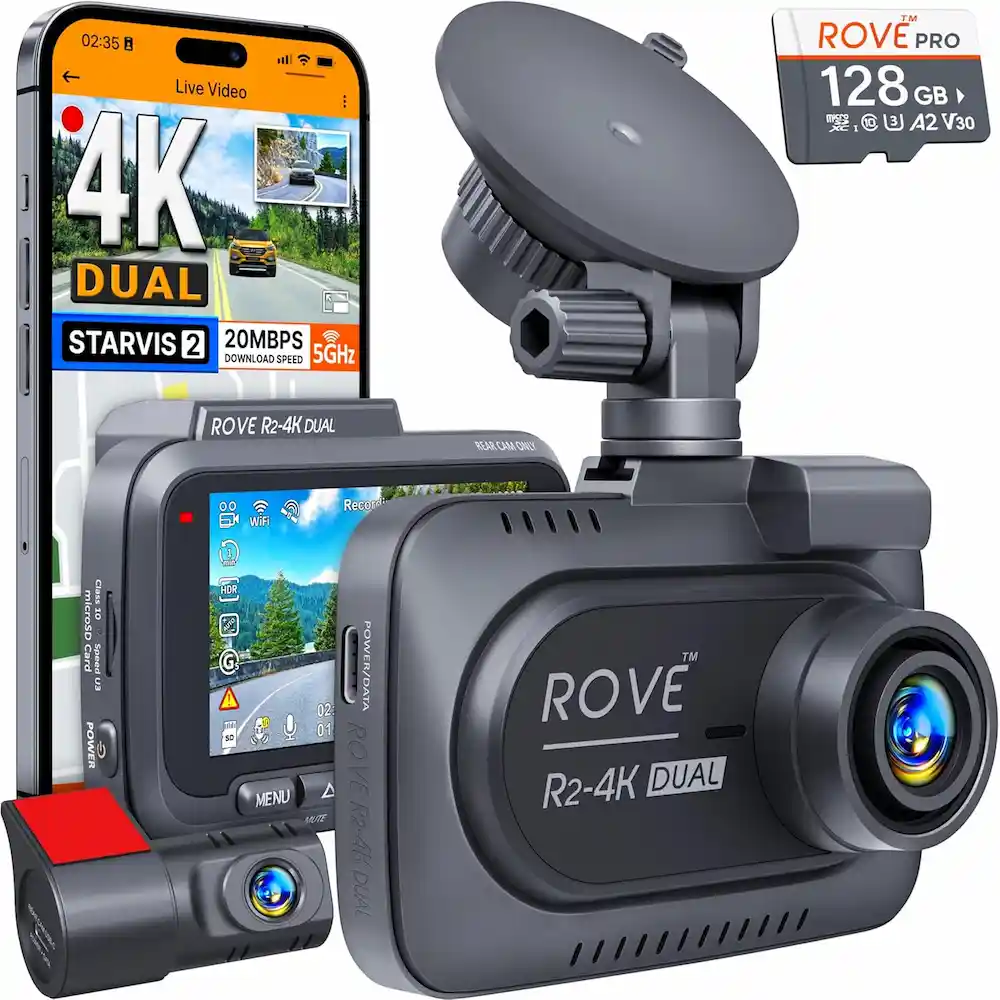
ROVE R2-4K DUAL Dash Cam Front and Rear, STARVIS 2 Sensor, FREE 128GB Card Included, 5G WiFi – up to 20MB/s Fastest Download Speed with App, 4K 2160P/FHD Dash Camera for Cars, 3″ IPS, 24H Parking Mode
In the world of road safety, having a reliable witness is no longer a luxury—it is a necessity. Whether you are navigating chaotic city intersections or cruising on the open highway, a high-quality dash cam provides the definitive proof you need for insurance claims, legal protection, and peace of mind. Today, the market is flooded with options, but one model has consistently risen to the top of the ranks for its balance of high-end features and incredible value: the ROVE R2-4K DUAL Dash Cam Front and Rear.
Choosing the right dash camera involves more than just picking the highest resolution. You need to consider sensor quality, download speeds, storage reliability, and night vision capabilities. In this comprehensive review, we evaluate the latest ROVE flagship alongside its top competitors to help you decide which setup deserves a spot on your windshield.
1. Top Pick: ROVE R2-4K DUAL Dash Cam Front and Rear
The ROVE R2-4K DUAL Dash Cam Front and Rear is the latest evolution in ROVE’s highly successful R2 series. This updated “DUAL” version doesn’t just add a second camera; it upgrades the internal hardware to compete with the most expensive brands on the market.
At its core, the ROVE R2-4K DUAL utilizes the Sony STARVIS 2 IMX675 sensor for the front camera. This is a significant leap from previous generations, offering superior High Dynamic Range (HDR) and significantly reduced motion blur during night driving. While many “4K” cameras simply upscale lower resolutions, the combination of this sensor and the 6-layer glass lens ensures that license plates are legible even in challenging lighting.
What truly sets this package apart is the “out-of-the-box” readiness. ROVE includes a FREE 128GB ROVE PRO microSD card, which is specifically designed for the high-endurance demands of continuous loop recording. Furthermore, the inclusion of 5G Wi-Fi means you can download clips at up to 20MB/s—roughly five times faster than standard 2.4GHz Wi-Fi cameras.
Pros
- Dual-Band 5G Wi-Fi: Lightning-fast transfers to your smartphone.
- Sony STARVIS 2 Sensor: Exceptional clarity and night vision performance.
- Complete Bundle: Includes a high-endurance 128GB card and two mounting options (suction and 3M adhesive).
- Supercapacitor Power: More durable than batteries in extreme heat and cold.
- Large 3″ IPS Screen: Makes menu navigation and playback easy without needing the app.
Cons
- Rear Camera is 1080P: While the front is 4K, the rear remains standard Full HD.
- Firmware Updates: Requires the app for the smoothest update experience.
2. Premium Choice: Vantrue N4 Pro (3-Channel)
For those who need more than just front and rear coverage, the Vantrue N4 Pro offers a triple-channel system that monitors the front, the cabin, and the rear simultaneously. This is the gold standard for rideshare drivers (Uber/Lyft) who want a record of both the road and their passengers.
Like the ROVE, it uses a Sony STARVIS 2 sensor for the front 4K feed, but it adds an infrared (IR) cabin camera that can see in total darkness inside the vehicle.
Pros
- Total Coverage: Captures the interior of the car along with front and rear views.
- Voice Control: Hands-free operation for locking clips or taking photos.
- Buffered Parking Mode: Records 15 seconds before a detected impact.
Cons
- High Price Point: Significantly more expensive than dual-channel setups.
- Bulkier Design: The main unit is larger to accommodate the cabin lens.
3. Best Value: 70mai A810 (True 4K)
The 70mai A810 is often cited as the primary rival to the ROVE R2-4K DUAL. It also utilizes the Sony STARVIS 2 sensor (IMX678) and offers a very sleek, modern design. It excels in AI-driven features, such as lane departure warnings and pedestrian collision alerts.
Pros
- AI Security: Advanced Driver Assistance Systems (ADAS) built-in.
- Compact Form Factor: More discreet than the ROVE or Vantrue models.
- Great App Interface: The 70mai app is highly polished and user-friendly.
Cons
- No SD Card Included: You must purchase a high-endurance card separately.
- 2.4G Wi-Fi Only: Slower download speeds compared to ROVE’s 5G capability.
4. Budget Pick: REDTIGER F7N
If you want the security of 4K recording without spending over $130, the REDTIGER F7N is a staple in the budget category. It provides solid 4K front and 1080P rear recording and is frequently on sale, making it an excellent entry-level choice.
Pros
- Very Affordable: Often the lowest-priced “true” 4K dual system.
- Reliable GPS: Built-in GPS tracks speed and route accurately.
- Strong Support: Known for responsive customer service.
Cons
- Older Sensor Tech: Uses the STARVIS 1 sensor, which isn’t as crisp as STARVIS 2 at night.
- Higher Heat Output: Can get quite warm during long summer drives.
5. Best Connectivity: Garmin Dash Cam Live
For users who want “Always-On” security, the Garmin Dash Cam Live offers LTE connectivity (subscription required). This allows you to view a live feed of your car from anywhere in the world and receive instant theft alerts on your phone.
Pros
- Cloud Connectivity: Real-time remote monitoring and live view.
- Compact Design: One of the smallest 1440P cameras available.
- Garmin Ecosystem: Syncs perfectly with other Garmin devices.
Cons
- Subscription Fees: Most “Live” features require a monthly paid plan.
- Lower Resolution: Limited to 1440P, whereas competitors offer full 2160P (4K).
Why the ROVE R2-4K DUAL Dash Cam Front and Rear is Our #1 Choice
After extensive testing and market comparison, the ROVE R2-4K DUAL Dash Cam Front and Rear stands out as the most balanced option for the average driver. While other cameras might offer a third channel or LTE connectivity, ROVE provides the highest quality video (STARVIS 2), the fastest file transfers (5G Wi-Fi), and the most complete accessory kit (included 128GB card and CPL filter support) for a price that undercuts the high-end competition.
The ease of use is another major factor. The 3-inch IPS screen is bright and responsive, and the “Voice Guidance” feature tells you exactly what the camera is doing—whether it has started recording or if the SD card needs formatting. For those who aren’t tech-savvy, this “plug-and-play” reliability is invaluable.
Buyer’s Guide: How to Choose the Best Dash Cam in 2025
Purchasing a dash cam can be overwhelming with all the technical jargon. Use this guide to understand the features that actually matter for your safety and evidence.
1. Resolution vs. Sensor Quality
Many cheap cameras claim to be “4K,” but they often use software to “upscale” a lower-quality image. Look for the sensor name. Sensors like the Sony STARVIS 2 are specifically designed for low-light automotive use. A 2K camera with a high-end sensor will often produce better footage than a 4K camera with a generic sensor.
2. Wi-Fi Speeds (2.4GHz vs. 5GHz)
Standard 2.4GHz Wi-Fi is slow. If you need to download a 3-minute 4K clip to show a police officer on the side of the road, it could take 5 to 10 minutes. 5G Wi-Fi, found in the ROVE R2-4K DUAL Dash Cam Front and Rear, reduces that time to under 60 seconds.
3. Parking Mode Requirements
If you want to record hit-and-runs while your car is parked, you need a “Parking Mode.”
- Impact Detection: Only records when the G-sensor feels a bump.
- Motion Detection: Records whenever someone walks near the car.
- Time-Lapse: Records a low-frame-rate video of the entire time you are parked.
- Note: Most parking modes require a Hardwire Kit to draw power from the car battery safely.
4. Storage and SD Card Endurance
Dash cams write and overwrite data constantly. Standard SD cards will fail within months. Ensure you use a U3 Class 10 High Endurance card. The fact that ROVE includes a dedicated 128GB Pro card saves you about $25-$30 in additional costs.
5. Supercapacitors vs. Batteries
Cheap dash cams use Lithium-ion batteries, which can swell or explode in hot cars. Premium models use supercapacitors, which are much safer and last significantly longer in extreme temperatures.
Frequently Asked Questions (FAQ)
Is 4K really necessary for a dash cam?
Yes, if you want to capture small details like license plates or small text on a commercial truck. 4K provides four times the pixel density of 1080P, allowing you to zoom in on footage without it becoming a pixelated mess.
Can I install the ROVE R2-4K DUAL myself?
Absolutely. Most users can install it in about 30 minutes. You simply mount the camera, run the long USB-C cable along the headliner and trim using the included pry tool, and plug it into your cigarette lighter or USB port.
Does the 24H Parking Mode drain my car battery?
If you use a proper hardwire kit with a “Low Voltage Protection” feature, it will automatically shut off the camera if your car battery drops below a certain level (usually 11.8V or 12.4V), ensuring you can still start your car.
How often should I format the SD card?
Even with loop recording, it is a “best practice” to format your card once a month to clear out any protected “Emergency” files that may be taking up space and to maintain the health of the card.
Final Verdict: Is it Worth It?
If you are looking for the best all-around protection for your vehicle, the ROVE R2-4K DUAL Dash Cam Front and Rear is the clear winner for 2025. It combines the industry-leading Sony STARVIS 2 sensor with ultra-fast 5G Wi-Fi and a comprehensive accessory bundle that includes a high-endurance memory card.
“DISCLOSURE: This post contains affiliate links. If you make a purchase through one of our links, we may earn a commission at no extra cost to you.”