
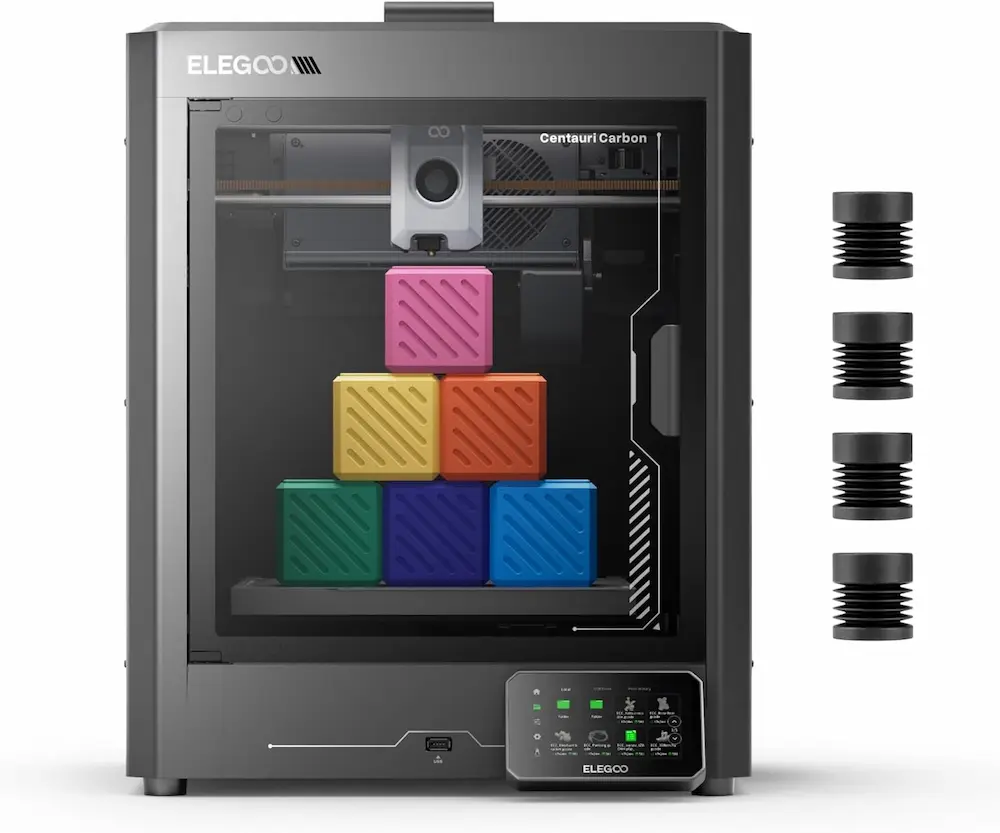
ELEGOO Centauri Carbon 3D Printer, CoreXY 500mm/s High Speed Printing with Auto Calibration (Quick Review)
The landscape of desktop fabrication has shifted dramatically in the last twelve months. We have moved away from the “bed-slinger” era and firmly into the era of high-speed, enclosed CoreXY systems. Leading this charge at an incredibly competitive price point is the ELEGOO Centauri Carbon 3D Printer.
For years, ELEGOO dominated the resin and budget FDM markets with the Mars and Neptune series. However, the ELEGOO Centauri Carbon 3D Printer represents a significant leap forward, offering a professional-grade enclosure, 500mm/s printing speeds, and full auto-calibration for under $400. This machine isn’t just a faster version of what came before; it is a ground-up redesign aimed at users who want Bambu-level performance without the “closed-ecosystem” price tag.
In this comprehensive review, we will evaluate the Centauri Carbon alongside four of its top competitors to see if it truly is the best value CoreXY printer of 2025.
1. Top Pick: ELEGOO Centauri Carbon 3D Printer
The ELEGOO Centauri Carbon 3D Printer is a masterclass in feature-to-price ratio. It utilizes a CoreXY motion system, which keeps the heavy motors stationary and allows the print head to move with incredible agility. With a 256x256x256mm build volume, it matches the industry standard set by premium competitors while adding unique features like a 320°C all-metal nozzle.
Performance and Speed
Running on a customized version of Klipper, the Centauri Carbon achieves 20,000mm/s² acceleration. In real-world terms, this means a standard “Benchy” boat prints in roughly 15-18 minutes without sacrificing structural integrity. The inclusion of Active Vibration Compensation ensures that even at these blistering speeds, the “ghosting” or “ringing” often seen on older printers is virtually eliminated.
Ease of Use
One of the most impressive aspects of the ELEGOO Centauri Carbon 3D Printer is its “out of the box” readiness. It features a 121-point auto-leveling system and a built-in AI camera for remote monitoring and time-lapse creation. The “Carbon” in its name isn’t just marketing; the machine is built with a die-cast frame and carbon fiber rod architecture to minimize weight and maximize rigidity.
Pros:
- Exceptional Value: Offers features usually reserved for $600+ printers at a much lower entry point.
- High-Temp Ready: The 320°C nozzle and 110°C bed allow for printing technical filaments like ASA, Carbon Fiber Nylon, and PC.
- Fully Enclosed: The steel and glass enclosure provides the thermal stability needed for warp-prone materials.
- Quiet Operation: Integrated silent motherboards keep the noise level below 50dB in standard modes.
Cons:
- Firmware Maturity: As a newer release, some UI menus feel slightly less polished than the Bambu ecosystem.
- Chamber Lighting: While it has internal LEDs, they can be a bit dim for the built-in camera to see dark filaments clearly.
2. The Gold Standard: Bambu Lab P1S
If the ELEGOO is the challenger, the Bambu Lab P1S is the incumbent champion. It is widely regarded as the most “appliance-like” 3D printer, meaning you send a file and it just works.
The P1S lacks the high-resolution touch screen of the Centauri Carbon (relying instead on a basic LCD or the mobile app), but it makes up for it with a rock-solid ecosystem. Its “AMS” (Automatic Material System) compatibility also makes it a favorite for those who want easy multi-color printing.
Pros:
- Unmatched Reliability: The software-hardware integration is the best in the industry.
- Excellent Slicer: Bambu Studio is highly optimized and user-friendly.
- AMS Compatibility: Easily upgradeable for 4-to-16 color printing.
Cons:
- Proprietary Ecosystem: Harder to mod or repair with third-party parts.
- Higher Price: Significantly more expensive than the Centauri Carbon for similar raw specs.
3. Best for Technical Filaments: Creality K1C
The “C” in K1C stands for “Carbon,” specifically referring to its ability to handle abrasive filaments out of the box. While the ELEGOO Centauri Carbon 3D Printer is a great all-rounder, the Creality K1C focuses heavily on a hardened-steel drivetrain.
It features a “Unicorn” nozzle that combines steel and copper to prevent clogs while maintaining heat conductivity. It is slightly faster on paper (600mm/s), though in practical use, the difference is negligible.
Pros:
- Abrasive-Ready: Hardened gears and nozzle are standard.
- Active Carbon Filter: Great for filtering out VOCs when printing ABS.
- Compact Footprint: Smaller overall size than the ELEGOO, despite a slightly smaller build plate.
Cons:
- Smaller Build Volume: 235mm vs 256mm makes a difference for larger functional parts.
- Vibration: Can be noisier at top speeds compared to the Centauri Carbon.
4. Best Budget Pick: Anycubic Kobra 3 Combo
For users who prioritize multicolor printing on a budget, the Anycubic Kobra 3 (often bundled with the ACE Pro) is the primary rival to the Centauri Carbon. While it is technically a “bed-slinger” and not a CoreXY, its speeds are surprisingly high.
However, it lacks the full enclosure found on the ELEGOO Centauri Carbon 3D Printer, making it less suitable for professional materials like ABS or Nylon.
Pros:
- Multicolor Ready: The ACE Pro system is a great alternative to Bambu’s AMS.
- Budget Friendly: Often the cheapest high-speed option on the market.
- Drying Feature: The ACE Pro unit actually dries your filament while you print.
Cons:
- Open Frame: Not suitable for materials that require a heated chamber/enclosure.
- Large Footprint: Requires a lot of desk space for both the printer and the color unit.
5. Best for Beginners: Flashforge Adventurer 5M Pro
The Flashforge Adventurer 5M Pro is designed for schools and households. It features a completely enclosed design and a “one-click” nozzle swap system that is the easiest in the business.
While its build volume is the smallest in this list (220mm cubed), its ease of maintenance and built-in HEPA filtration make it a very safe and “friendly” machine for newcomers.
Pros:
- Safety First: Dual filtration (HEPA + Carbon) is excellent for indoor use.
- Tool-less Nozzle Swap: Change nozzles in seconds without tools.
- Very Stable: High-quality linear rails ensure consistent quality.
Cons:
- Small Build Area: 220mm can be limiting for larger cosplay or mechanical projects.
- Price: Often priced higher than the more capable Centauri Carbon.
Buyer’s Guide: How to Choose the Right High-Speed Printer
When searching for a machine like the ELEGOO Centauri Carbon 3D Printer, it is easy to get lost in the marketing jargon. Here are the critical factors you need to consider before hitting the “buy” button.
1. CoreXY vs. Bed-Slinger
In a CoreXY system, the bed only moves up and down (Z-axis). This allows the printer to maintain high speeds without the “momentum” of a heavy bed moving back and forth, which usually causes quality issues. If you want speed and precision, CoreXY—the system used in the Centauri Carbon—is the superior choice.
2. Temperature and Materials
If you only plan to print PLA (the most common plastic), almost any printer will work. However, if you want to print functional parts:
- Nozzle Temp: Look for 300°C or higher (The Centauri Carbon offers 320°C).
- Heated Bed: Should reach at least 100°C for ABS/ASA.
- Enclosure: Essential for keeping heat in and preventing parts from cracking or warping.
3. Auto-Calibration Features
Manual bed leveling is the #1 reason people quit 3D printing. Modern machines now offer “Full Auto Calibration.” This includes:
- Auto-Leveling: Using sensors to map the bed.
- Auto Z-Offset: Calculating the exact distance between the nozzle and the bed.
- Vibration Compensation: Tuning the motors to cancel out shakes.The ELEGOO Centauri Carbon 3D Printer handles all of these automatically, making it “Plug and Play.”
4. Smart Monitoring
Built-in cameras are no longer a luxury. They allow you to check on your print via a smartphone app. Advanced systems (like the AI in the Centauri Carbon) can even detect “spaghetti” (print failures) and pause the machine automatically, saving you from wasting a whole roll of filament.
Final Verdict: Why the ELEGOO Centauri Carbon Wins
After analyzing the current market, the ELEGOO Centauri Carbon 3D Printer stands out as the most balanced option for 2025. It successfully bridges the gap between the “budget” printers that require constant tinkering and the “pro” printers that cost a month’s rent.
With its 500mm/s speed, 256mm build volume, and enclosed carbon-fiber reinforced frame, it provides a platform that grows with you. Whether you are a hobbyist printing figurines or an engineer prototyping functional nylon parts, the Centauri Carbon delivers the reliability and speed required for modern 3D printing.
“DISCLOSURE: This post contains affiliate links. If you make a purchase through one of our links, we may earn a commission at no extra cost to you.”