
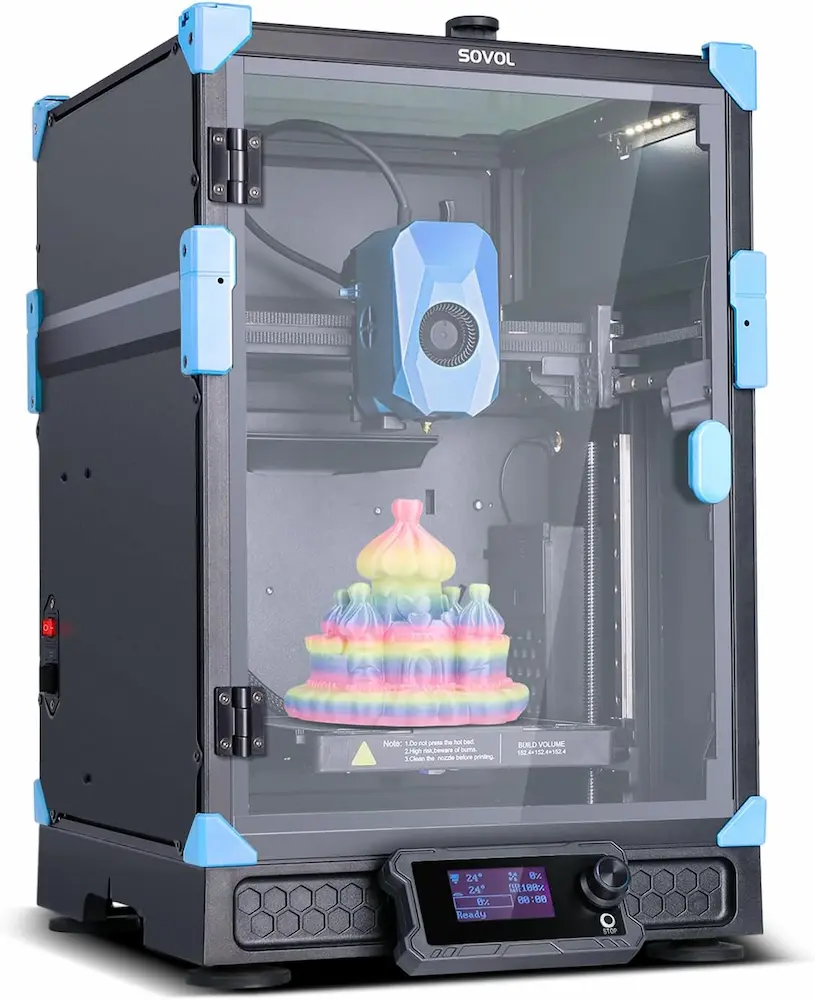
Sovol Zero 3D Printer: 1200mm/s High Speed CoreXY 3D Printer with Eddy Scanning & Pressure Sensing (Review)
The landscape of desktop 3D printing is shifting faster than a print head on a CoreXY rail. If you are a maker, engineer, or hobbyist looking for industrial-grade performance in a compact footprint, the Sovol Zero 3D Printer represents the bleeding edge of what is possible in 2025. This machine isn’t just another entry in the “mini” category; it is a high-speed powerhouse designed to tackle technical filaments that would make standard “bed-slingers” choke.
In this comprehensive review, we will explore how the Sovol Zero 3D Printer achieves its staggering 1200mm/s top speed and why features like Eddy Scanning and Pressure Sensing are changing the game for first-layer reliability. Whether you are choosing between this and a Bambu Lab A1 Mini or considering building a Voron kit from scratch, this guide will help you decide if the Sovol Zero is the right fit for your workshop.
The Top 5 Small-Format High-Speed 3D Printers of 2025
Choosing the right printer requires balancing speed, build volume, and the complexity of the materials you intend to use. Below are our top picks for the small-format category.
1. Sovol Zero 3D Printer – Top Pick for Speed & Performance
The Sovol Zero 3D Printer is currently the speed king of the small-format world. Taking heavy inspiration from the open-source Voron V0.2 design but arriving almost fully assembled, it offers a “pro-sumer” experience out of the box. With a blistering 1200mm/s print speed and 40,000mm/s² acceleration, it can finish a standard Benchy in under 10 minutes without breaking a sweat.
What sets it apart is the specialized sensor suite. The “Auto-Leveling 3.0” system uses Eddy Current Scanning to map the bed magnetically in seconds, followed by Pressure Sensing to fine-tune the Z-offset. This ensures a perfect first layer even at extreme speeds.
Pros:
- Unrivaled 1200mm/s speed for rapid prototyping.
- Enclosed design with a 350°C nozzle and 120°C heated bed.
- XYZ Full Linear Rails for maximum rigidity.
- Open-source Klipper firmware for advanced customization.
Cons:
- Small 6x6x6 inch build volume limits larger projects.
- High-speed fans and motors can be quite noisy.
2. Bambu Lab A1 Mini – Best for Beginners
If you want a printer that “just works” with zero tinkering, the Bambu Lab A1 Mini is the gold standard. While it lacks the enclosure of the Sovol Zero, its ecosystem and AMS Lite (multi-color) compatibility make it an attractive choice for those who value ease of use over raw speed and material versatility.
Pros:
- Incredible “plug-and-play” setup.
- Optional AMS Lite for 4-color printing.
- Extremely quiet operation.
Cons:
- Open frame makes it unsuitable for ABS or Nylon.
- Lower nozzle temperature (300°C) compared to Sovol Zero.
3. Voron V0.2 (LDO Kit) – Best for Tinkers & Enthusiasts
The Voron V0.2 is the spiritual ancestor of the Sovol Zero. If you enjoy the process of building a machine from the ground up, an LDO kit offers high-quality components and a deep community knowledge base. It is the ultimate “forever printer” because every single part is replaceable and upgradable.
Pros:
- Unmatched community support and modding potential.
- Ultra-compact and highly efficient.
- Teaches you everything about 3D printer mechanics.
Cons:
- Requires 15–20 hours of assembly.
- More expensive than the pre-built Sovol Zero.
4. Creality Ender-3 V3 – Budget Speed Choice
Creality has finally modernized the Ender line with the V3, utilizing a CoreXZ motion system that mimics the speed of CoreXY. While it has a larger build volume than the Sovol Zero, it lacks the full enclosure and the high-temp capabilities (350°C) found on the Zero.
Pros:
- Very affordable price point for the speed.
- Larger build volume for general-purpose printing.
- Simple assembly.
Cons:
- Not as stable as a CoreXY machine at high speeds.
- Requires a separate enclosure for technical materials.
5. Flashforge Adventurer 5M – Best for Education
The Adventurer 5M is an enclosed, robust machine that prioritizes safety and reliability. It features a quick-swap nozzle system and a fully enclosed environment, making it ideal for classrooms or offices where air filtration and ease of maintenance are priorities.
Pros:
- Tool-less nozzle changes.
- Strong air filtration system.
- Reliable auto-leveling.
Cons:
- Proprietary ecosystem is less flexible than Klipper.
- Speed is capped significantly lower than the Sovol Zero.
Deep Dive: The Sovol Zero Advantage
When we look at the Sovol Zero 3D Printer, we aren’t just looking at a small machine; we are looking at a concentrated effort to bring engineering-grade features to the desktop. Let’s break down the technical specifications that make this machine a “Level 10” recommendation for serious makers.
CoreXY Kinematics & 1200mm/s Speed
Most hobbyist printers use “i3” or “bed-slinger” designs where the heavy print bed moves back and forth. This creates inertia that causes “ghosting” or “ringing” at high speeds. The Sovol Zero 3D Printer utilizes a CoreXY motion system. In this setup, the bed only moves on the Z-axis, while the lightweight print head handles all X and Y movements.
Combined with XYZ Full Linear Rails, this allows the Zero to reach 1200mm/s and 40,000mm/s² acceleration. To put that in perspective, this machine is roughly 4 to 5 times faster than a standard Ender-3.
Next-Gen Auto-Leveling: Eddy Scanning & Pressure Sensing
Leveling a 3D printer bed used to be a chore. The Sovol Zero uses a hybrid approach:
- Eddy Current Scanning: This sensor uses magnetic induction to “map” the metal build plate without ever touching it. It can scan hundreds of points in seconds.
- Pressure Sensing: To ensure the nozzle is at the exact right height (the Z-offset), the nozzle actually taps the bed. The pressure sensor detects the moment of contact with micron-level precision.
The result is a perfect first layer, every single time, regardless of whether you’ve just changed a nozzle or moved the printer.
High-Temp Material Support
With a 350°C nozzle and a 120°C AC-heated bed, the Sovol Zero is designed for more than just PLA. The AC bed heats up significantly faster than standard DC beds, reaching 100°C in under two minutes. This capability, combined with the fully enclosed chamber and integrated air filtration, makes the Sovol Zero a perfect candidate for:
- ABS & ASA: For UV-resistant outdoor parts.
- PA (Nylon): For high-strength mechanical gears.
- PC (Polycarbonate): For heat-resistant transparent parts.
- Carbon Fiber Composites: For ultra-stiff structural components.
H2: Buyer’s Guide – How to Choose a Small-Format 3D Printer
Buying a small-format printer like the Sovol Zero 3D Printer involves different considerations than buying a large-scale machine. Because the build volume is limited (typically around 150mm³), you are trading size for speed and precision. Here is what you need to look for:
1. Motion System: CoreXY vs. Bed-Slinger
If speed is your priority, always choose CoreXY. The structural rigidity of the Sovol Zero’s cube-frame allows it to maintain accuracy at speeds where an open-frame printer would vibrate itself apart. Linear rails are also a must-have for long-term reliability and smoothness.
2. Maximum Operating Temperatures
Many “high-speed” printers are still limited to 260°C or 300°C at the nozzle. If you plan to print functional parts, look for a machine that can reach at least 350°C. Additionally, ensure the bed can hit 110°C–120°C. High-performance plastics like ABS will warp and peel if the bed isn’t hot enough.
3. Firmware and Connectivity
Does the printer run Klipper? Klipper is the modern standard for high-speed printing because it uses an external processor to handle the heavy math of “Input Shaping” (canceling out vibrations). The Sovol Zero comes with Klipper pre-installed, allowing you to monitor your prints via a web interface and even use a built-in camera for time-lapses.
4. Enclosure and Air Filtration
Small printers are often used on desks in bedrooms or small offices. Printing technical filaments like ABS releases VOCs (Volatile Organic Compounds) that can be harmful. The Sovol Zero 3D Printer includes an air filtration system and a full enclosure, making it safer for indoor use compared to open-frame alternatives.
5. Automation Features
Look for “Quality of Life” features:
- Filament Runout Sensor: Pauses the print when you run out of plastic.
- Power Loss Recovery: Saves your progress if the power cuts out.
- Auto-Z Offset: Ensures you don’t have to manually adjust the height between the nozzle and the bed.
Comparison Table: At a Glance
| Feature | Sovol Zero | Bambu A1 Mini | Voron V0.2 Kit |
| Max Speed | 1200mm/s | 500mm/s | 250-500mm/s |
| Max Temp | 350°C / 120°C | 300°C / 80°C | 300°C+ / 110°C |
| Enclosed? | Yes | No | Yes |
| Firmware | Klipper | Proprietary | Klipper |
| Auto-Level | Eddy + Pressure | Load Cell | Optional Probe |
Frequently Asked Questions (FAQ)
Is 1200mm/s actually usable for real prints?
While 1200mm/s is the “burst” speed, real-world print speeds for high-quality parts usually hover between 300mm/s and 600mm/s. The high top speed is an indicator of the machine’s motor strength and rigidity, which results in better quality even at lower speeds.
Can I upgrade the Sovol Zero?
Yes! One of the best things about the Sovol Zero 3D Printer is that it is open-source. Since it is based on the Voron V0.2, most community-designed mods for the Voron can be adapted to the Zero.
Is the build volume too small?
A 6x6x6 inch (152mm³) volume is larger than a standard Voron V0 (120mm³) but smaller than an Ender-3 (220mm³). It is perfect for 90% of household prints, figurines, and mechanical parts, but you won’t be printing full-sized helmets in one piece.
Final Thoughts: Is the Sovol Zero Worth It?
The Sovol Zero 3D Printer is a specialized tool. It is not just a “mini” printer; it is a high-speed, high-temp laboratory in a box. With its XYZ Full Linear Rails and revolutionary Eddy Scanning technology, it eliminates the most common headaches of 3D printing: bed leveling and slow turnaround times.
“DISCLOSURE: This post contains affiliate links. If you make a purchase through one of our links, we may earn a commission at no extra cost to you.”