
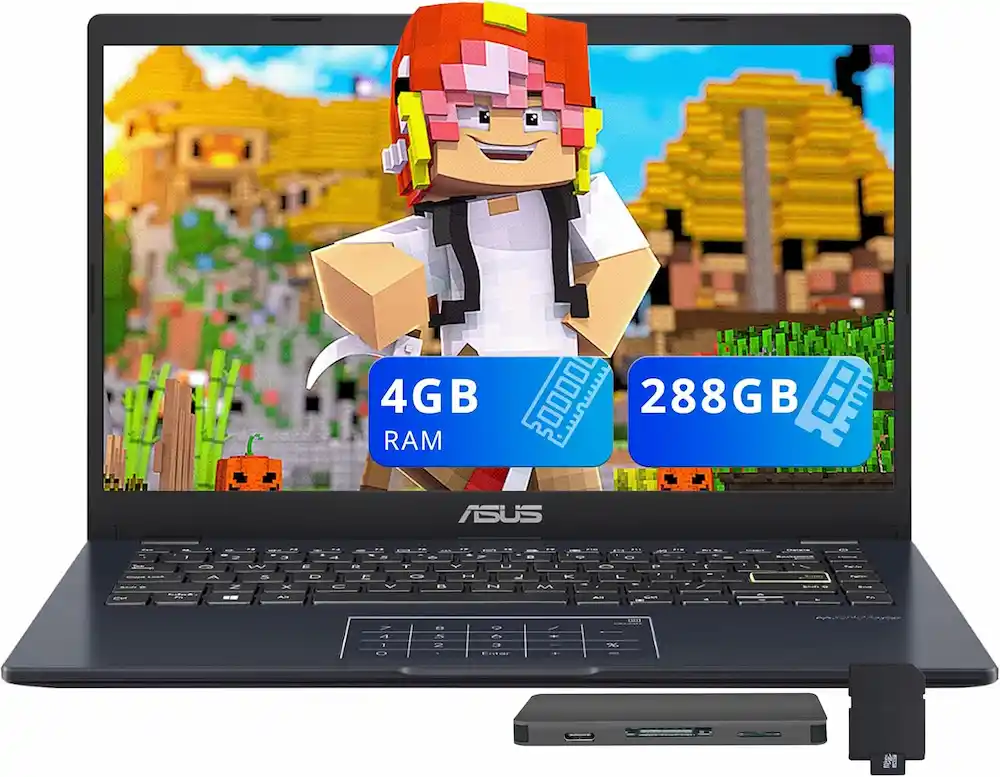
ASUS Vivobook Go 14″ FHD Laptop, Intel Celeron N4500, 4GB DDR4 RAM (Quick Review)
Finding a reliable laptop that doesn’t break the bank is the ultimate challenge for students and remote professionals. The ASUS Vivobook Go 14″ FHD Laptop, Intel Celeron N4500, 4GB DDR4 RAM, 288GB Storage(128GB eMMC + 160GB Docking Station Set), Intel UHD Graphics, Number Pad, Webcam, Wi-Fi 5, Win 11 S, Star Black is designed to bridge that gap.
In this comprehensive review, we evaluate whether this specific configuration—boasting a unique hybrid storage solution and the efficiency of the Celeron N4500—lives up to the demands of modern computing. We will also compare it against four other top-tier budget contenders to help you decide which ultraportable is truly worth your investment.
5 Best Budget Ultraportable Laptops of 2025 Compared
| Product Name | Best For | Key Feature |
| ASUS Vivobook Go 14″ | Overall Value | Hybrid Storage & NumberPad |
| Acer Aspire Go 15 | Large Screen | 15.6″ FHD Display |
| HP Stream 14″ | Ultra-Budget | Lightweight Design |
| Lenovo IdeaPad Slim 3 | Durability | Military-Grade Testing |
| Samsung Galaxy Chromebook 2 | Media Consumption | QHD+ Vibrant Screen |
1. Top Pick: ASUS Vivobook Go 14″ FHD Laptop (Intel Celeron N4500)
The ASUS Vivobook Go 14″ FHD Laptop, Intel Celeron N4500, 4GB DDR4 RAM, 288GB Storage(128GB eMMC + 160GB Docking Station Set), Intel UHD Graphics, Number Pad, Webcam, Wi-Fi 5, Win 11 S, Star Black stands out because it solves the biggest complaint of budget laptops: storage. By including a docking station set that boosts the total storage to 288GB, it handles more files than your average entry-level PC.
Performance and Usability
Powered by the Intel Celeron N4500, this laptop is a fanless, silent worker. It is perfect for writing, streaming, and light web browsing. The “Star Black” finish gives it a professional look that punches well above its price class.
Pros:
- Unique Storage: The 288GB total capacity (via the docking set) is rare at this price point.
- Portability: At just 2.87 lbs, it’s incredibly easy to carry to a coffee shop or lecture hall.
- Innovative Trackpad: Features the ASUS NumberPad for quick data entry.
Cons:
- Limited Multitasking: 4GB of RAM means you should stick to 5-7 browser tabs at once.
- S Mode: Comes in Windows 11 S Mode (though you can switch to full Windows 11 for free).
2. Budget Pick: Acer Aspire Go 15
If you prefer a larger canvas for your work, the Acer Aspire Go 15 is the go-to alternative. While it lacks the fancy NumberPad of the ASUS Vivobook Go 14″ FHD Laptop, it offers a massive 15.6-inch screen that makes split-screen multitasking much more comfortable.
Pros:
- Spacious Display: Large 15.6″ screen is great for older users or those with eye strain.
- Full Keyboard: Includes a dedicated physical numeric keypad.
- Excellent Battery: Often reaches 10-12 hours of real-world use.
Cons:
- Bulkier: Noticeably heavier and harder to fit into small backpacks than the ASUS.
- Build Quality: The chassis has more “flex” and feels more plastic-heavy.
3. Best for Portability: HP Stream 14″
The HP Stream has long been the rival to the ASUS Vivobook series. It is designed for those who live entirely in the cloud. It is slightly thinner than the ASUS but offers significantly less storage out of the box.
Pros:
- Vibrant Colors: Available in colors like Indigo Blue and Rose Pink.
- Serviceability: HP has a vast network of repair centers.
- Thin Profile: Extremely sleek design.
Cons:
- Low Storage: Usually limited to 64GB or 128GB without the ASUS docking station advantage.
- Display: Often uses a lower-resolution 720p panel compared to the ASUS FHD (1080p).
4. Best for Students: Lenovo IdeaPad Slim 3
Lenovo’s entry-level Slim 3 is built to survive the “backpack life.” It is slightly more rugged than the ASUS Vivobook Go 14″ FHD Laptop, though it lacks the sophisticated NumberPad integration.
Pros:
- Privacy Shutter: Includes a physical slide to block the webcam.
- Fast Charging: Can get to 80% battery in about an hour.
- Quiet Operation: Optimized thermal management.
Cons:
- Dim Screen: The peak brightness is often lower than the Vivobook Go.
- Standard Design: Lacks the “Star Black” premium aesthetic.
5. Best for Media: Samsung Galaxy Chromebook 2 360
If your “work” is mostly watching Netflix or attending Zoom calls, the Samsung Galaxy Chromebook 2 360 is a formidable opponent. It runs ChromeOS instead of Windows 11, which makes it faster on the same Intel Celeron N4500 hardware.
Pros:
- Amazing Screen: High-resolution QHD+ touch display.
- 2-in-1 Design: Can flip into a tablet mode.
- Speed: ChromeOS is much lighter than Windows for 4GB RAM systems.
Cons:
- Software Limits: You cannot run standard Windows (.exe) programs.
- Price: Usually more expensive than the ASUS Vivobook Go.
Buyer’s Guide: How to Choose a Budget Laptop in 2025
When shopping for a laptop like the ASUS Vivobook Go 14″ FHD Laptop, Intel Celeron N4500, 4GB DDR4 RAM, 288GB Storage, you need to prioritize specific specs to ensure the machine remains usable for 3–4 years.
1. Processor (CPU)
The Intel Celeron N4500 is a dual-core processor. In 2025, this is considered the “baseline.” It is excellent for “thin-client” tasks—meaning apps that run in a browser. If you plan to do video editing or heavy gaming, you will need to step up to an Intel Core i3 or Ryzen 3.
2. RAM and Multitasking
Most budget laptops come with 4GB of RAM. While this is sufficient for Windows 11 S Mode, it is the bare minimum.
- 4GB: Good for one main task (e.g., Word) + 2 background tabs.
- 8GB: The “sweet spot” for 2025 if you can find it within your budget.
3. Storage Solutions
Standard budget laptops offer 64GB or 128GB of eMMC storage. The ASUS Vivobook Go 14″ FHD Laptop configuration we reviewed is unique because it utilizes a 128GB eMMC base plus a 160GB docking station set. This is a game-changer for users who have large photo libraries or need to store offline videos.
4. Display Quality
Don’t settle for “HD” (720p) in 2025. Always look for FHD (1920 x 1080). The ASUS Vivobook Go 14″ provides this, ensuring that text is crisp and movies look sharp.
Deep Dive: The ASUS Vivobook Go 14″ FHD Laptop Experience
Display and Visuals
The 14-inch Full HD display is the centerpiece of this machine. With a 78% screen-to-body ratio, the bezels are thin enough to look modern. While it isn’t an OLED panel, the anti-glare coating makes it highly usable in bright classrooms or near windows.
The NumberPad Innovation
One of the most annoying parts of a 14-inch laptop is the lack of a numeric keypad. ASUS solves this by embedding a LED-illuminated numeric keypad into the touchpad. You can toggle it on when you’re doing spreadsheets and off when you need to navigate. It’s a genius use of space that makes the ASUS Vivobook Go 14″ FHD Laptop feel like a larger productivity machine.
Connectivity and Expansion
Despite its thinness, you get a healthy selection of ports:
- USB-C 3.2 for fast data transfer.
- HDMI 1.4 for connecting to external monitors or projectors.
- The Star Black chassis also houses a 720p webcam with clear enough quality for Microsoft Teams and Zoom.
Final Verdict: Is the ASUS Vivobook Go 14″ Right for You?
The ASUS Vivobook Go 14″ FHD Laptop, Intel Celeron N4500, 4GB DDR4 RAM, 288GB Storage(128GB eMMC + 160GB Docking Station Set), Intel UHD Graphics, Number Pad, Webcam, Wi-Fi 5, Win 11 S, Star Black is a specialized tool. It isn’t a gaming rig or a workstation; it is a highly portable, aesthetically pleasing, and storage-rich laptop for the everyday user.
If you are a student who needs to write papers and store years of lecture recordings, or a home user who wants a sleek device for emails and banking, this Vivobook is one of the best values on the market. The inclusion of the docking station storage set effectively doubles its utility compared to its competitors.
Who should buy this?
- Students on a strict budget.
- Writers and bloggers who need a great keyboard and portability.
- Users who need more storage than the typical 64GB budget laptop offers.
Who should skip this?
- Professional video editors.
- Hardcore gamers.
- Users who refuse to use Windows S Mode (though remember, you can switch out!).
“DISCLOSURE: This post contains affiliate links. If you make a purchase through one of our links, we may earn a commission at no extra cost to you.”