
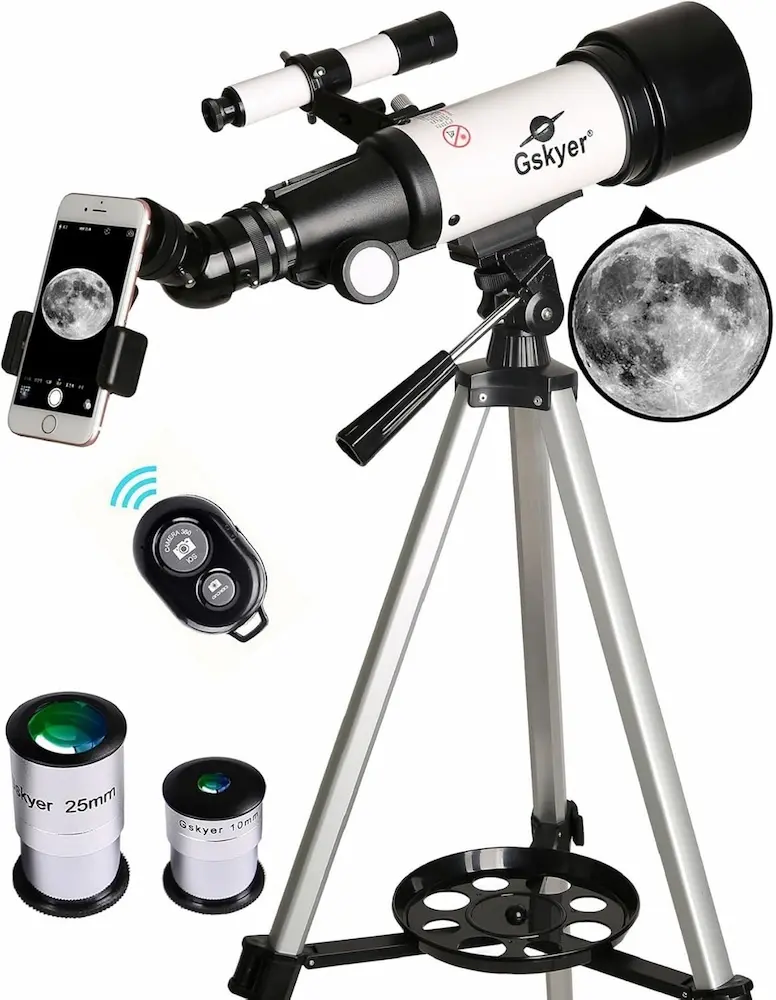
Gskyer Telescope, 70mm Aperture 400mm AZ Mount Astronomical Refracting Telescope for Kids Beginners (Quick Review)
Are you looking to unlock the mysteries of the night sky without breaking the bank? The Gskyer Telescope, 70mm Aperture 400mm AZ Mount Astronomical Refracting Telescope for Kids Beginners has become a gold standard for entry-level stargazing. Whether you are a parent looking for an educational gift or a hobbyist seeking a portable “grab-and-go” setup, this telescope offers a blend of quality optics and user-friendly features that are hard to beat in its price range.
In this comprehensive guide, we will review the Gskyer 70mm model alongside four other top contenders in the beginner category to help you decide which optic is right for your celestial journey.
1. Top Pick: Gskyer Telescope, 70mm Aperture 400mm AZ Mount
The Gskyer 70mm is the quintessential beginner’s scope. It features a 400mm focal length and a 70mm aperture, which provides a significant increase in light-gathering power compared to smaller 50mm or 60mm models. This allows for crisp views of the Moon’s craters, the rings of Saturn, and even some brighter deep-sky objects like the Orion Nebula.
Pros
- High-Quality Optics: Fully coated glass lenses with high transmission coatings create stunning images and protect your eyes.
- Complete Accessory Kit: Includes two replaceable eyepieces (10mm and 25mm) and a 3x Barlow lens, effectively tripling the magnification power.
- Smart Features: Comes with a smartphone adapter and a wireless camera remote, making astrophotography accessible for beginners.
Cons
- Lightweight Tripod: While portable, the aluminum tripod can be a bit shaky in high winds.
- Fine Adjustment: The AZ mount is easy to use but lacks the precision slow-motion controls found on higher-end equatorial mounts.
2. Best for Portability: Celestron Travel Scope 70
If your stargazing adventures take you away from city lights and into the wilderness, the Celestron Travel Scope 70 is a formidable rival to the Gskyer. It is designed specifically with the traveler in mind.
Pros
- Ultra-Compact: Fits entirely into a custom-designed backpack (included).
- Day-to-Night Use: Excellent for terrestrial viewing (birds, wildlife) as well as basic astronomy.
- Brand Reliability: Backed by Celestron’s world-class customer support and warranty.
Cons
- Basic Accessories: The included eyepieces are decent but not as high-quality as some aftermarket options.
- Aperture Limits: Like the Gskyer, 70mm is limited for viewing very faint galaxies.
3. Best for Tech Enthusiasts: Celestron StarSense Explorer LT 80AZ
For those who struggle to find objects in the night sky, this telescope uses your smartphone to “plate solve” and guide you to stars, planets, and nebulae in real-time.
Pros
- StarSense Technology: No complicated alignment process; simply dock your phone and follow the arrows.
- Larger Aperture: The 80mm lens offers a 30% increase in light-gathering power over 70mm models.
- Sturdy Build: Features a more stable mount than most entry-level kits.
Cons
- Higher Price Point: You are paying a premium for the software and larger glass.
- Phone Dependent: The best features require a compatible smartphone.
4. Best Budget Pick: Hestia Telescope for Kids and Adults
If you are on a strict budget but still want a functional instrument that isn’t a “toy,” the Hestia 70mm offers the essentials needed to see the Moon and bright planets.
Pros
- Extremely Affordable: Often priced lower than the Gskyer while maintaining the same 70mm aperture.
- Easy Setup: No tools required; can be assembled in under 5 minutes.
- Educational: Great way to test interest in the hobby without a large investment.
Cons
- Lower Quality Barlow: The magnification lens can introduce some chromatic aberration (purple fringing).
- Plastic Components: More plastic used in the focuser and mount than higher-end models.
5. Best Upgrade: Orion Observer 90mm Equatorial Refractor
For the beginner who is serious about the hobby and wants to learn how professional astronomers track stars, the Orion Observer 90mm is a significant step up.
Pros
- Large 90mm Lens: Drastically better resolution on planetary details like Jupiter’s cloud bands.
- Equatorial (EQ) Mount: Allows you to track the movement of stars by turning a single slow-motion knob.
- Superior Stability: A much heavier tripod that minimizes vibrations.
Cons
- Steep Learning Curve: The EQ mount takes time to learn how to align with the North Star (Polar Alignment).
- Weight: Not as “grab-and-go” as the Gskyer 70mm.
Comprehensive Buyer’s Guide: Choosing Your First Telescope
Selecting the right telescope, like the Gskyer Telescope, 70mm Aperture 400mm AZ Mount, requires understanding a few fundamental optical principles. Don’t be fooled by high “magnification” claims on the box—clarity is far more important than size.
Aperture: The Most Important Spec
The aperture is the diameter of the primary lens or mirror. A 70mm aperture is the “sweet spot” for beginners. It is large enough to show you the rings of Saturn and the moons of Jupiter, but small enough to keep the telescope portable and affordable.
Refractor vs. Reflector
The Gskyer is a Refractor, meaning it uses lenses to bend light.
- Refractors: Low maintenance, great for crisp images of planets, and double as spotting scopes for land use.
- Reflectors: Use mirrors. They offer more aperture for the money but require “collimation” (aligning the mirrors) periodically.
Understanding the Mount (AZ vs. EQ)
- Alt-Azimuth (AZ): Moves up/down and left/right. It is intuitive, like a camera tripod. The Gskyer 70mm uses this, making it perfect for kids and beginners.
- Equatorial (EQ): Tilted to match the Earth’s axis. It’s better for high-power tracking and astrophotography but is more complex to set up.
Key Accessories to Look For
- Eyepieces: Look for a kit that provides at least two different focal lengths (e.g., 25mm for wide views and 10mm for close-ups).
- Barlow Lens: This sits between the eyepiece and the telescope to double or triple magnification.
- Finderscope: A small “mini-scope” mounted on top to help you aim the main telescope.
Why the Gskyer 70mm is the Ideal Entry Point
The reason the Gskyer Telescope, 70mm Aperture 400mm AZ Mount Astronomical Refracting Telescope for Kids Beginners consistently tops the charts is its balance of value and performance. It doesn’t overwhelm the user with complexity, yet it provides “real” glass optics that deliver genuine scientific views.
When you first see the craters of the Moon through the 10mm eyepiece, the clarity is breathtaking. The inclusion of the smartphone adapter is the “cherry on top,” allowing you to take photos of your discoveries to share with friends and family immediately.
Maintenance and Care Tips
- Never look at the Sun: Without a professional solar filter, you can cause permanent eye damage.
- Avoid touching the glass: Use a specialized lens pen or microfiber cloth if the lens gets dusty.
- Acclimation: Let your telescope sit outside for 20 minutes before viewing to allow the glass to adjust to the temperature, which prevents blurry images caused by heat waves.
Final Verdict
If you want a reliable, easy-to-use, and highly portable instrument, the Gskyer 70mm remains the best overall choice for beginners. It bridges the gap between a toy and a professional tool, providing a rewarding experience every time the clouds clear.
“DISCLOSURE: This post contains affiliate links. If you make a purchase through one of our links, we may earn a commission at no extra cost to you.”