
💨 The 5 Best Small Air Purifiers for Dorm Rooms (Quiet Operation & Allergy Relief) (Quick Review)
Dorm rooms: they’re compact, often poorly ventilated, and can quickly become a breeding ground for dust, odors, and common allergens like pollen and pet dander carried in on clothing. If you’re heading off to college or simply living in a smaller space, investing in a high-quality room air purifier isn’t a luxury—it’s a necessity for your health, focus, and overall well-being.
The Best Small Air Purifiers for Dorms at a Glance
| Pick Label | Model | Key Feature | CADR (Smoke) | Max Room Size (AHAM) | Noise Level |
| Top Pick (Overall) | Blueair Blue Pure 511i Max | Quiet HEPASilent™ Tech & Smart App | 153 CFM | 237 sq. ft. | 19 – 48 dB |
| Best Budget Pick | Levoit Core 300S | Excellent Value & Filter Options | 141 CFM | 219 sq. ft. | 24 – 50 dB |
| Best for Large Dorms | Coway Airmega AP-1512HH Mighty | High CADR for Maximum Coverage | 234 CFM | 361 sq. ft. | 36.3 – 60.3 dB |
| Quietest Operation | Winix A231/A230 | True HEPA + PlasmaWave Technology | 154 CFM | 231 sq. ft. | 27.8 – 50 dB |
| Best Portable | PureZone Mini Portable Air Filter | Rechargeable Battery & Compact | Low | 54 sq. ft. (Personal) | 30 – 50 dB |
5 In-Depth Reviews of the Top-Rated Small Air Purifiers
To ensure your investment is worthwhile, we’ve structured our reviews around the needs of students and small-space dwellers: ultra-quiet operation, powerful allergy relief, and a small footprint.
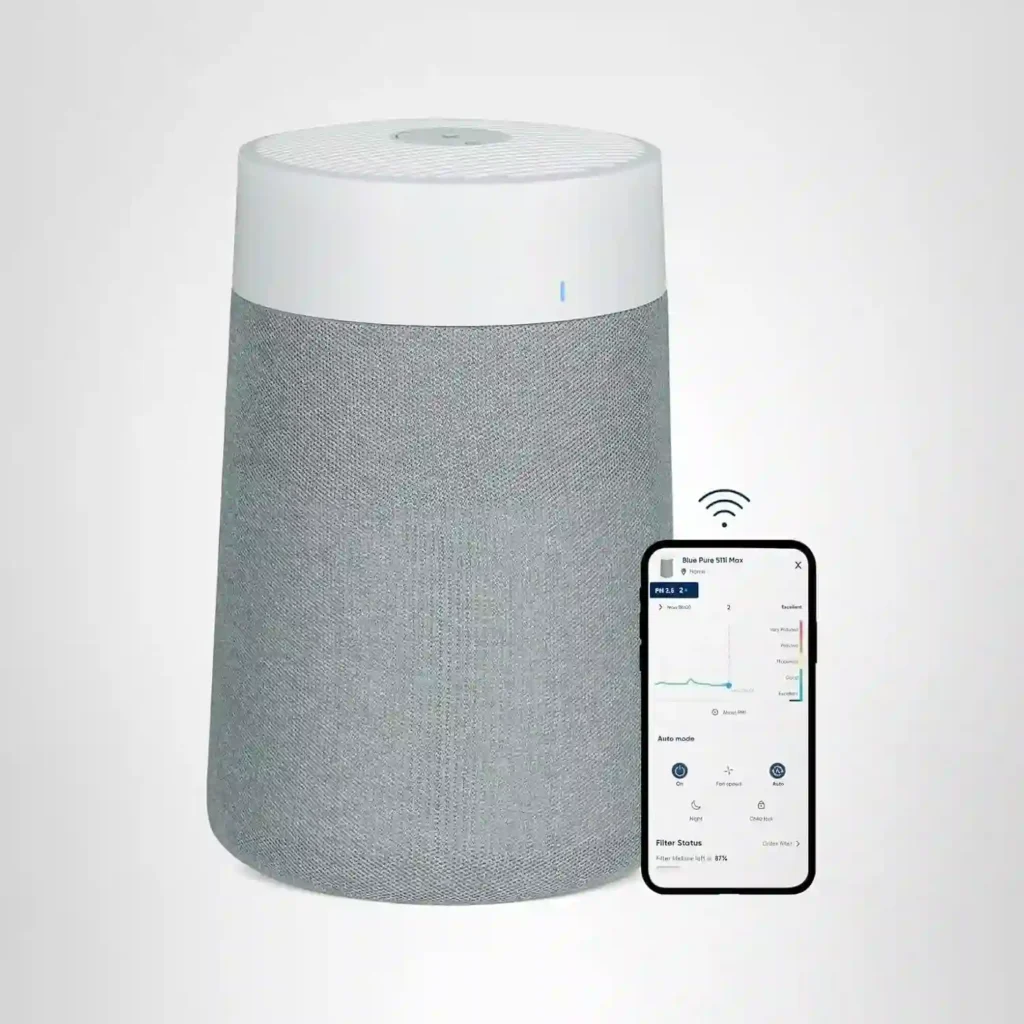
1. Top Pick: Blueair Blue Pure 511i Max – The Smart and Silent Room Air Purifier
The Blueair Blue Pure 511i Max takes our top spot because it perfectly balances smart features, powerful filtration, and a whisper-quiet operation that is essential for a study or sleep environment. Using Blueair’s proprietary HEPASilent™ technology, it captures 99.97% of airborne particles like pollen, dust, viruses, and pet dander down to 0.1 microns, all while using less energy and producing minimal noise. The smart features—including a real-time air quality sensor, filter life tracking, and app control—make it a truly set-it-and-forget-it solution for the busy student.
| Pros | Cons |
| Ultra-Quiet Operation: Noise level as low as 19 dB, virtually silent in Night Mode. | Filter Not True HEPA: Uses HEPASilent™ tech (a blend of mechanical/electrostatic), which some prefer over traditional HEPA. |
| Advanced Smart Features: Blueair app for remote control, scheduling, and filter life. | Air Quality Indicator: Can be slow to react to smoke/VOC spikes. |
| Compact 360° Design: Looks great and can be placed virtually anywhere. | Pre-Filter Material: Some users may not like the cloth pre-filter aesthetic. |
| HEPASilent™ Technology: Combines electrostatic and mechanical filtration for high efficiency and low energy use (17W). |
Why it won: The 511i Max is a powerhouse in a small package. Its combination of smart monitoring, high CADR for its size, and impressively low noise level makes it the ultimate room air purifier for maintaining a clean, quiet, and healthy dorm or small bedroom.
2. Best Budget Pick: Levoit Core 300S Air Purifier
The Levoit Core 300S is perhaps the most popular compact air purifier on the market, and for good reason: it delivers professional-grade air cleaning at an accessible price. This unit uses True HEPA filtration to capture 99.97% of particles $0.3$ microns in size. Its cylindrical design pulls air from all sides, offering great air change efficiency for small to medium rooms. While the original Core 300 is great, the ‘S’ model adds smart features like app control, which adds tremendous value without breaking the bank.
| Pros | Cons |
| Exceptional Value: Top-tier performance for a budget-friendly price point. | Filter Cost: While the unit is cheap, replacement filters are a recurring expense. |
| True HEPA Filtration: Preferred filtration standard for maximum allergen removal. | Highest Fan Speed: Can be noticeably louder than the Blueair on max settings. |
| Quiet Sleep Mode: Features a display light-off mode for complete darkness and quiet operation. | No Washable Pre-Filter: The pre-filter is integrated and requires periodic vacuuming. |
3. Best for Large Dorms/Suites: Coway Airmega AP-1512HH Mighty
While this article focuses on small air purifiers, many students live in larger dorm suites or shared apartments. This is where the Coway Airmega Mighty shines. It’s the highest-rated air purifier in its class for a reason, offering an astonishing CADR for a compact form factor. Its four-stage filtration system includes a pre-filter, an odor filter, a True HEPA filter, and an ionizer (optional). If your dorm or shared space has persistent odors (cooking, mildew, etc.) or if your allergies are severe, the sheer power and comprehensive filtration of the Coway Mighty make it a worthwhile splurge.
| Pros | Cons |
| Industry-Leading Performance: One of the highest CADR ratings in its compact class. | Larger Footprint: Not as tiny as the Core 300S or 511i Max; takes up more space. |
| Four-Stage Filtration: Excellent odor and VOC removal thanks to the activated carbon layer. | Noise on Max: Definitely audible on the highest setting. |
| Eco Mode: Automatically shuts off the fan if air quality remains clean for 30 minutes. | Aesthetic: More utilitarian look compared to the sleek tower designs. |
4. Quietest Operation: Winix A231/A230 Air Purifier
For the student who absolutely cannot tolerate noise during study sessions or while sleeping, the Winix A231 is the undisputed champion of quiet purification. It’s slightly taller than some competitors but features a sleek, modern design. The Winix uses a robust four-stage filtration process that includes its proprietary PlasmaWave Technology, which safely breaks down airborne pollutants at a molecular level. Crucially, its fan is designed for minimal sound, making it perfect for placing right next to your bed.
| Pros | Cons |
| Near-Silent Sleep Mode: Highly rated for its exceptionally low operational noise. | PlasmaWave Feature: While safe, some users prefer to avoid ionizer technology completely (it is optional). |
| Fine Mesh Pre-Filter: Catches pet hair and large dust particles easily. | Filter Availability: Not as widely available as Levoit or Blueair filters in all retail locations. |
| High CADR for Size: Powerful purification without sacrificing its compact design. |
5. Best Portable: PureZone Mini Portable Air Filter
The life of a student is often on the move: from the dorm to the library, to a friend’s apartment, or even back home for the holidays. For personal, on-the-go air cleaning, the PureZone Mini Portable is the ideal room air purifier. It’s compact enough to fit in a backpack or on the corner of a small library desk, and it runs on a rechargeable battery, giving you cordless freedom for hours. While its purification area is much smaller (designed for personal space, not a whole room), it offers an essential shield against airborne irritants wherever you go.
| Pros | Cons |
| Rechargeable Battery: Offers cordless operation, ideal for portability and power outages. | Small Coverage Area: Only suitable for personal desk space, not a whole room. |
| Incredibly Compact: Fits easily on any desk, nightstand, or even a car cup holder. | Lower CADR: Purification power is significantly less than the tabletop models. |
| Simple USB-C Charging: Easy to power up with standard student electronics. | No Smart Features: Fully manual control with no app connectivity. |
💡 The Buyer’s Guide: Everything a Student Needs to Know About Air Purifiers
Choosing the right room air purifier for a dorm room is a nuanced decision. Unlike a large house, a small room magnifies every detail, from the unit’s size to its lowest fan setting. Here are the critical factors to consider, ensuring you pick a unit that truly enhances your living and study environment:
Understanding Air Purification Metrics
The most important specifications to look at for a small air purifier are its purification power, its noise level, and its energy efficiency.
1. Clean Air Delivery Rate (CADR)
The CADR score, measured in Cubic Feet per Minute (CFM), is the industry standard for how quickly an air purifier can remove pollutants. It’s reported for three particle types: smoke, dust, and pollen.
- For a typical dorm room (150-250 sq. ft.): Look for a Smoke CADR of 130 CFM or higher. This ensures the unit can clean the air multiple times per hour, which is essential for quickly removing odors and irritants.
- The 511i Max at 153 CFM (Smoke) is an excellent baseline.
2. Air Changes Per Hour (ACH)
This metric tells you how many times per hour the purifier can cycle all the air in your room.
- For Allergy/Asthma sufferers: You want 4.8 ACH (or 5X) to ensure rapid removal of irritants. All the top models listed above meet this requirement for their respective room sizes.
3. Noise Level (dB)
Since your dorm room is also your bedroom, noise is critical. Air purifiers use fans, and fans make noise.
- Acceptable Dorm Noise: Look for a “Sleep Mode” or “Low Setting” that operates at 30 dB or lower. This is roughly the volume of a whisper or rustling leaves—perfectly conducive to sleep. The Blueair 511i Max at 19 dB is exceptional in this regard.
Filtration Technology Explained
Not all filters are created equal. For allergy sufferers and clean air advocates, understanding the filter type is paramount.
- HEPA (High-Efficiency Particulate Air): This is the gold standard, capturing 99.97% of particles down to $0.3$ microns. This targets pollen, pet dander, mold spores, and most dust.
- True HEPA: Filters that meet or exceed the official HEPA standard.
- HEPASilent™ (Blueair): A hybrid technology that combines mechanical filtration with electrostatic charging. This means the filter fibers are less dense, allowing the fan to run quieter and use less energy while still achieving the 99.97% capture rate.
- Activated Carbon Filter: This layer is a must-have for dorm rooms! It uses highly porous carbon to absorb gaseous pollutants and odors, which includes cooking smells, cleaning chemicals, VOCs (Volatile Organic Compounds), and even new furniture off-gassing.
- Ionizers (e.g., PlasmaWave): These release charged ions into the air to clump particles together, making them easier for the filter to capture. While effective, some health organizations recommend checking for ozone emission (most modern, high-quality models have zero or near-zero ozone emission, but it’s a personal preference).
Key Dorm-Specific Features to Prioritize
Beyond performance, the unit must integrate seamlessly into a student’s busy life and cramped quarters.
- Small Footprint: Look for vertical, tower-style designs or compact cylinders like the Levoit Core 300S and Blueair 511i Max. These designs offer 360° air intake and take up less valuable surface area.
- Filter Indicator: A must-have! All the recommended units feature a filter replacement indicator—or even better, a smart app that tracks filter life based on usage and air quality, preventing you from forgetting or changing filters too soon.
- Auto Mode/Air Quality Sensor: A good room air purifier should monitor the air and adjust its fan speed automatically. This saves energy and ensures you always get the cleaning power you need when pollutants spike (like when your roommate walks in or you start cooking a late-night snack).
- Display Lock: Especially useful if your purifier is on a low table. This feature prevents accidental setting changes from bumps or curious hands.
The Health Factor: Allergy Relief and Focus
For many students, an air purifier is a medical necessity. Dust mites, pollen, and mold spores are major triggers for allergies and asthma, and they thrive in low-ventilation environments. By consistently running a high-quality unit, you significantly reduce the pollutant load in the air. Cleaner air means:
- Better Sleep: Fewer nighttime sniffling and coughing fits, leading to deeper, more restorative sleep.
- Improved Focus: Less congestion and fewer allergy symptoms mean less distraction and more energy for studying.
- Odor Elimination: Never worry about mildew smells, old food odors, or lingering roommate smells again—a clean scent promotes a clear mind.
🤝 Conclusion: Making the Final Decision on Your Room Air Purifier
Choosing a room air purifier is a long-term investment in your health and academic success. You need a compact machine that offers quiet, powerful, and efficient cleaning.
Our research overwhelmingly points to the Blueair Blue Pure 511i Max as the superior choice for the vast majority of dorm room dwellers. Its revolutionary HEPASilent™ technology provides the perfect trifecta: best-in-class air cleaning, near-silent operation, and energy efficiency. The smart connectivity adds a level of convenience that fits perfectly into the modern student’s life.
However, if budget is your absolute number one concern, the Levoit Core 300S is an outstanding alternative that delivers True HEPA filtration at an unbeatable price point. For those with larger shared spaces or high traffic, the powerful CADR of the Coway Airmega Mighty is a necessary upgrade.
No matter which of these five top-rated models you choose, you can be confident that you’re taking a critical step toward creating a healthier, more productive, and much more comfortable living space for the next academic year. Breathe deep, study hard, and enjoy the clean air!
Frequently Asked Questions (FAQ)
Q1: Do air purifiers actually help with dorm room odors?
Yes, absolutely. The key component for odor removal is the Activated Carbon Filter. Common dorm smells like stale food, laundry, VOCs from new carpets or furniture, and personal odors are gaseous pollutants. A high-quality carbon filter, like those found in the Blueair 511i Max and the Coway Airmega Mighty, traps these gas molecules, effectively eliminating the smell instead of just masking it.
Q2: How often do I need to replace the filter in a small room air purifier?
Filter life typically ranges from 6 to 12 months, depending on usage and air quality. Running the unit constantly on a high setting in a polluted environment (like during wildfire season or heavy shedding from a pet) will deplete the filter faster. Look for smart units, like the Blueair 511i Max, which use an algorithm (RealTrack) to accurately track filter life based on actual pollutant levels and usage, not just a timer.
Q3: Should I get a model with an ionizer (like PlasmaWave)?
Ionizer technology, such as the PlasmaWave found in the Winix A231, is designed to enhance purification by breaking down airborne contaminants. Modern, certified ionizers are generally considered safe and release little to no ozone. It’s an optional feature. If you have any sensitivities or concerns, you can simply disable the ionizer feature on the unit and rely solely on the HEPA and carbon filtration.
Q4: Where is the best place to put my air purifier in a small room?
For maximum effectiveness, place your room air purifier in a central location where it has 360-degree access to the air, such as in the middle of a desk or on the floor. Avoid placing it directly against a wall, as this can block the air intake or exhaust and reduce efficiency. Since most dorms are one room, its strategic placement is less about zoning and more about ensuring good airflow circulation.
“DISCLOSURE: This post contains affiliate links. If you make a purchase through one of our links, we may earn a commission at no extra cost to you.”